Gentleman spy : the life of Allen Dulles by Grose Peter 1934-
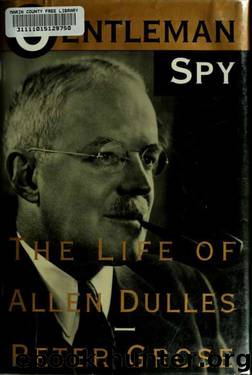
Author:Grose, Peter, 1934- [Grose, Peter, 1934-]
Language: eng
Format: epub
Tags: Dulles, Allen Welsh, 1893-1969, United States. Central Intelligence Agency, Spies, Intelligence service
Publisher: Boston : Houghton Mifflin
Published: 1994-06-22T19:00:00+00:00
GENTLEMAN SPY
smoking pipes, and full of daring, innovative ideas, who had flocked to the Agency as the most effective place for a non-communist liberal to do
battle against the communist menace I was glad to be back within
this dedicated and stimulating band. 29
But more than class and culture separated the two hemispheres of Allen's clandestine services. The collection apparatus, OSO, had become an established service, with budget and pay scales adjusted only for inflation. The OPC, by contrast, had to recruit new people, and that meant offering higher pay. Performing the similar functions of running agents and exploiting targets of opportunity, the "amateurs" were better paid. Even worse, the OPC was expanding while the OSO was static; a bright recruit seeking reward and promotion knew where to turn.*
Most serious for Allen in balancing the two cultures was the operational fact that the OSO and the OPC marched to different drummers. Intelligence collection requires silent long-term care and commitment; covert actions demand immediate impact. A network that collects intelligence could — and should — go undetected for years; a successful sabotage operation is immediately obvious and provokes immediate counter-measures. The enthusiasts of the OPC seemed like "reckless adventurers" to OSO officers, who understandably feared that their own tediously nurtured networks would be blown by the demands for fast action. 30 The two branches were running separate networks on the same turf, bidding for the same agents. Gehlen, funded by the OSO, fought off lucrative offers from the newcomers of the OPC. Their separate operations to infiltrate East Germany often ended in the betrayal of one by the other. Competing subsidies to the same emigre organizations only resulted in separate files of worthless information.
Both of the clandestine services sought global coverage, and outside Europe the competition for local agents and resources became even more intense. On the defensive in Korea, General MacArthur finally lifted his ban on CIA field activity in his east Asian theaters, and both the OSO and the OPC rushed in with cash offers to any well-placed officer or entrepreneur who seemed to have good potential as an agent; needless to say, the world capitals were full of plucky souls capable of recognizing the Americans as a bonanza. CIA-funded corruption and competition rose to a crisis in the Bangkok station early in 1952, when Smith had to send top officials of both clandestine branches out to untangle a mess of opium trading under the cover of efforts to topple the Chinese communists.
* Helms, however, was farsighted enough to stand as an exception; he opted for the professional safety of intelligence collection, the OSO, rather than the more glamorous OPC. He followed Allen, after two short-timers, as director of central intelligence in 1966.
Download
This site does not store any files on its server. We only index and link to content provided by other sites. Please contact the content providers to delete copyright contents if any and email us, we'll remove relevant links or contents immediately.
| Elections & Political Process | Ideologies & Doctrines |
| International & World Politics | Political Science |
| Public Affairs & Policy | Specific Topics |
| United States |
The Secret History by Donna Tartt(18998)
The Social Justice Warrior Handbook by Lisa De Pasquale(12177)
Thirteen Reasons Why by Jay Asher(8873)
This Is How You Lose Her by Junot Diaz(6856)
Weapons of Math Destruction by Cathy O'Neil(6248)
Zero to One by Peter Thiel(5765)
Beartown by Fredrik Backman(5710)
The Myth of the Strong Leader by Archie Brown(5481)
The Fire Next Time by James Baldwin(5409)
How Democracies Die by Steven Levitsky & Daniel Ziblatt(5200)
Promise Me, Dad by Joe Biden(5130)
Stone's Rules by Roger Stone(5065)
A Higher Loyalty: Truth, Lies, and Leadership by James Comey(4937)
100 Deadly Skills by Clint Emerson(4899)
Rise and Kill First by Ronen Bergman(4758)
Secrecy World by Jake Bernstein(4727)
The David Icke Guide to the Global Conspiracy (and how to end it) by David Icke(4684)
The Farm by Tom Rob Smith(4486)
The Doomsday Machine by Daniel Ellsberg(4473)
